
Paying by April 15 and paying on time are not the same thing and your wallet can feel the difference.
If you’re self-employed, own a business, collect investment income, or earn money that shows up in your bank account with little or no tax taken out, you’ve probably been told to make quarterly estimated tax payments. And you’ve probably also assumed that as long as you settle up by April 15, everyone’s happy.
It’s a reasonable assumption. It’s also, unfortunately, how a lot of people end up with a penalty they never saw coming.
The IRS operates on a “pay as you go” system. It generally expects tax to be paid throughout the year, as you earn the income, not in one heroic lump sum when you file. Understanding how that works can save you money, spare you a surprise at filing time, and keep your cash flow a lot calmer.

The big idea in one graphic: income earned → tax paid throughout the year → no underpayment penalty.
The Question the IRS Is Actually Asking
Most people think the important question is: “Did I pay my whole tax bill by April 15?”
For estimated taxes, the IRS is asking something different: “Did you pay enough by each required due date along the way?”
Those are not the same question, and the gap between them is where penalties live. If you earn most of your income in the spring but don’t make a payment until December — or until you file — you can still owe a penalty for the earlier quarters you skipped. The IRS has a long memory and excellent record-keeping.
When Payments Are Due
For most calendar-year individual taxpayers, estimated payments land on four dates. Note that they are not evenly spaced.
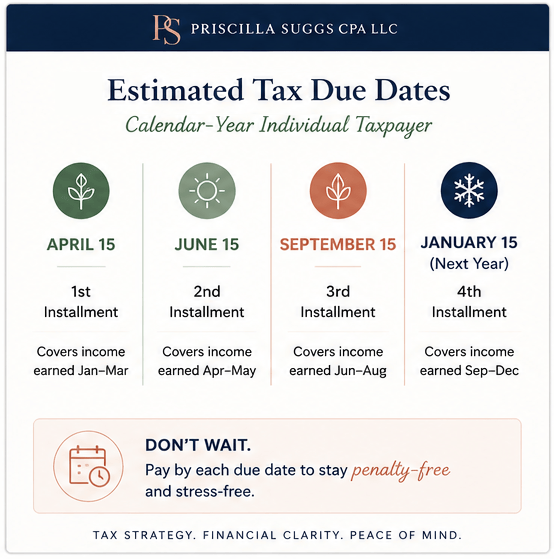
Four due dates, one uneven calendar. April 15, June 15, September 15, and January 15 of the following year.
Between now and each of those dates, the IRS tallies what you’ve paid in through a combination of federal income tax withholding and estimated tax payments. If the running total is high enough at each checkpoint, you’re in the clear.
How Much Counts as “Enough”?
Here’s the good news: you don’t have to predict your exact tax bill to the penny. The IRS offers “safe harbors” — targets that, if you hit them, protect you from an underpayment penalty even if you end up owing more at filing.
Generally, you want to pay the lesser of:
- 90% of your current year’s total tax, or
- 100% of last year’s tax — bumped to 110% if your prior-year adjusted gross income was over $150,000 ($75,000 if married filing separately).

Two safe harbors and one handy exception. Hit any of these and the penalty generally disappears.
For a lot of people, the prior-year safe harbor is the easy button: last year’s number is already known, so you get a fixed, predictable target — even in a year when your income is bouncing around like a toddler on a trampoline.
Why Timing Matters (Yes, Even If You Pay in Full)
Estimated payments are generally applied to the earliest unpaid installment first. That detail quietly trips up a lot of well-meaning people.
Say you owe $5,000 by April 15 and another $5,000 by June 15, and you make one $10,000 payment on September 15. That payment first backfills April, then June. It reduces what you owe — but it does not make the April payment magically on time. A penalty may have been quietly accruing from April all the way to September while you were busy living your life.
This is exactly why the year-end “I’ll just catch up in December” strategy doesn’t always erase the penalty. The tax gets paid; the timing damage is already done.

A September payment fills April first, then June. Later money doesn’t rewrite earlier deadlines.
Withholding’s Quiet Superpower
Now for a genuinely useful quirk. Wage withholding gets treated very differently from estimated payments.
Federal income tax withheld from your paycheck is generally treated as if it were paid evenly throughout the year — even if you crank it way up in November. Estimated payments only count from the date you actually send them; withholding gets to time-travel.

Same dollars, different timing rules. Withholding is spread evenly; estimated payments count only when they land.
That means bumping up your paycheck withholding — or having extra withheld from a year-end bonus — can sometimes patch up an earlier shortfall better than a late estimated payment ever could. If you have wage income alongside your side income, this is a lever worth knowing about.
What If Your Income Isn’t Even?
Not everyone earns in tidy, equal quarters. Life is lumpier than that. This especially applies to:
- Business owners with seasonal revenue
- Independent contractors and freelancers
- Folks exercising stock options or vesting RSUs
- Investors who realize a big capital gain late in the year
If your income shows up in bursts, the annualized income installment method may let you match your required payments to when the money actually arrived — so you’re not penalized for a January that was quiet and a November that was not. It’s more paperwork, but for uneven earners it can meaningfully lower what you owe each quarter.
Will a Late Payment Always Cost You?
No — and that’s worth saying plainly. A late payment does not automatically trigger a penalty. The IRS weighs several things, including whether:
- You paid enough by the applicable due date
- You satisfied a safe harbor
- Your remaining tax after withholding was under $1,000
- You qualified for another statutory exception
- The annualized income installment method applies to you
Every taxpayer’s facts are a little different, which is exactly why planning your estimated taxes usually beats simply throwing money at them and hoping.
Practical Tips
✓ Set your payments off a safe harbor — not the balance you’re hoping to owe in April.
✓ Pay by each due date whenever you can.
✓ Don’t assume a big year-end payment wipes out earlier-quarter penalties.
✓ Consider increasing withholding if you’ve fallen behind.
✓ If your income swings hard during the year, ask whether the annualized method could lower your required payments. Be prepared to compile your earnings by month.
The Bottom Line
Quarterly estimated taxes are about timing as much as amount. The IRS wants enough tax paid throughout the year — not simply by the filing deadline. Understanding safe harbors, how payments get applied, and the withholding trick can shrink your penalties and eliminate the springtime surprises.
If your income changes during the year, you’re self-employed, you collect investment income, or you’re expecting a large bonus, stock sale, or business profit, it’s worth reviewing your estimated tax strategy before the next due date. A little planning now tends to be a lot cheaper than a penalty later.
Not sure which safe harbor applies to you, or how much to send this quarter? Let’s look at your numbers and build a plan that fits your income and your cash flow.